Disaster Mitigation Landscapes in the Philippines: A Scoping Review of Policy Frameworks, Institutional Gaps, and Community Resilience (2015–2025)
DOI:
https://doi.org/10.5281/zenodo.19413449Keywords:
Mitigation, Disaster, Philippines, ResilienceAbstract
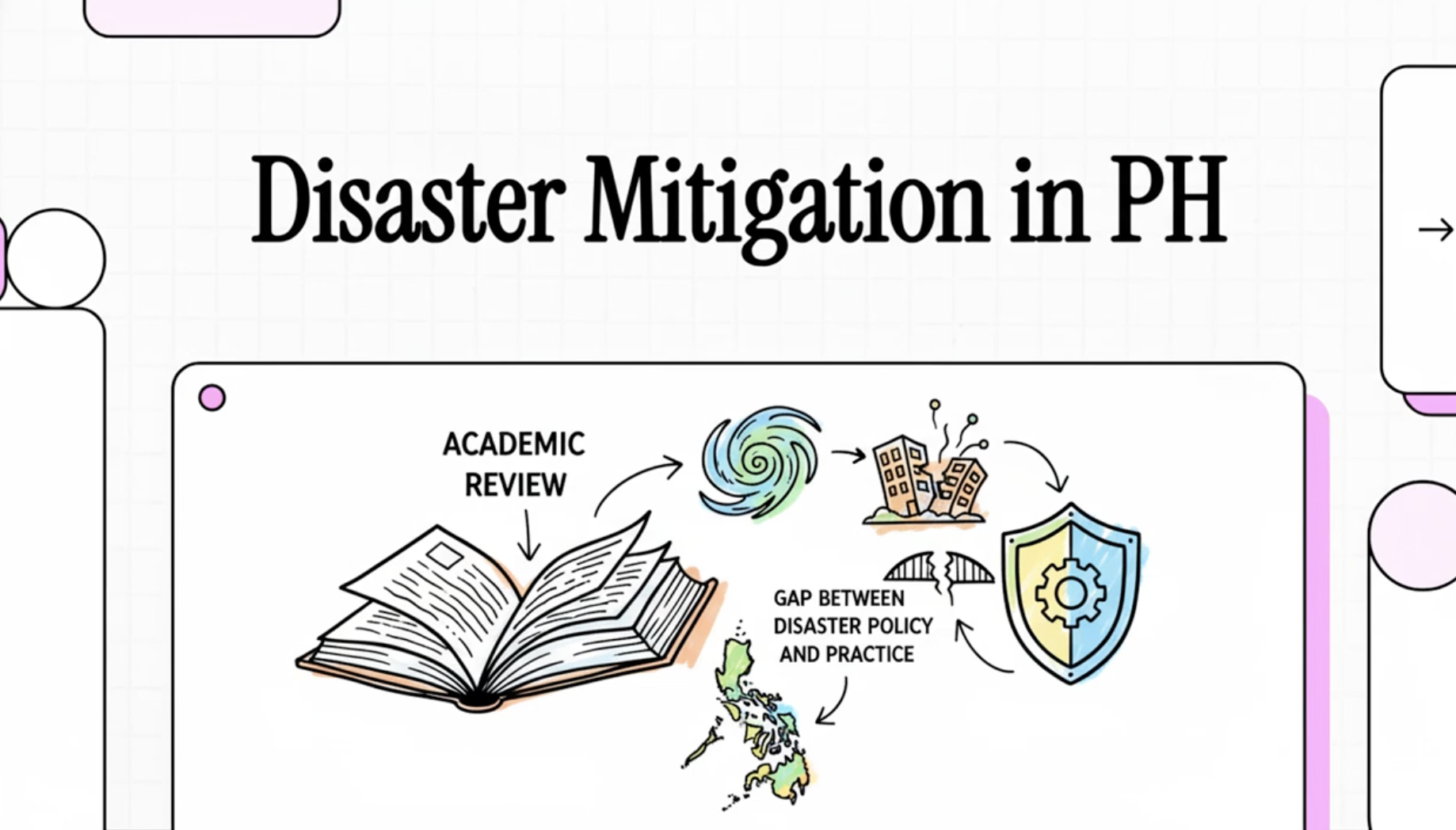
Because of where it is in the world, the Philippines is quite prone to many natural disasters, which shows how important it is to have strong disaster mitigation plans. The purpose of this study was to find all the available research on disaster mitigation in the Philippines so that we could learn more about what we already know. It aims to tackle essential research inquiries concerning the principal issues and methodologies, along with the advantages, disadvantages, and results of current tactics. It also sought to pinpoint deficiencies in research. The study methodically searched significant databases, such as Scopus, Web of Science, Philippine E-Journals, and Google Scholar, using a set protocol and PRISMA-ScR criteria. It then combined 15 papers that were published in English between 2015 and 2025. The results showed important themes, such as Disaster Risk Reduction and Management (DRRM) methods, community readiness, and an in-depth understanding of how geography affects susceptibility. New issues that came up were social entrepreneurship in disaster recovery, how disasters affect poverty, and how to keep cultural heritage alive. The analysis of the mitigation strategies revealed strengths in resilient policy frameworks and community-oriented initiatives. But it also showed problems, like local Disaster Risk Reduction and Management (DRRM) councils that don't have enough people, problems with monitoring, and a lack of operational testing for preparedness plans. Some important research gaps that have been found are the need for a better knowledge of community resilience, socio-ecological systems, and the things that make it hard to share information. The assessment also stressed how important it is to do thorough evaluations of how ready local governments are, look at institutional problems in more depth, and study how climate change affects vulnerability over time. This study stresses the need for ongoing, evidence-based work to make the Philippines stronger. It suggests that more money should be spent on building local capability, making policies work better and evaluating them, putting research first, and making big changes to how the government works.
Downloads
References
Ado, R. G., Escober, R. E., & Masbate, A. J. (2015). Design of a Data Build-up Framework and Development of a Dashboard Derived from Natural Disasters’ Historical Data for the Philippines. International Journal of Innovation, Management and Technology.
Alcayna, T., Bollettino, V., Dy, P., & Vinck, P. (2016). Resilience and Disaster Trends in the Philippines: Opportunities for National and Local Capacity Building. PLOS Current Disasters.
Calumba, S. R., Rith, M., & Fillone, A. M. (2021). Earthquake Evacuation Choice and Management in a Developing Archipelagic Country—A Case Study of Surigao City, Philippines. Sustainability, 13(11), 5783. https://doi.org/10.3390/su13115783
Chandra, Y., & Paras, A. (2021). Social entrepreneurship in the context of disaster recovery: Organizing for public value creation. Public Management Review.
Chua, G. R. (2015). Dismantling Disaster, Death, and Survival in Philippine Ecopoetry. Kritika Kultura.
Concha, N. C. (2020). A deterministic approach of generating earthquake liquefaction severity map of mindoro philippine. International Journal of Geomate, 18(70). https://doi.org/10.21660/2020.70.9308
Dariagan, J. D., Atando, R. B., & Asis, J. L. B. (2021). Disaster preparedness of local governments in Panay Island, Philippines. Natural Hazards, 105(2), 1923. https://doi.org/10.1007/s11069-020-04383-0
Domingo, S. N., & Manejar, A. A. (2018). Disaster preparedness and local governance in the Philippines. Philippine Institute for Development Studies.
Florentin, K., Onuki, M., Esteban, M., Valenzuela, V., Paterno, M., Akpedonu, E., Garciano, L. (2021). Implementing a Pre-disaster Recovery Workshop in Intramuros, Manila, Philippines: lessons for disaster risk assessment, response, and recovery for cultural heritage. Disasters.
Geronimo, M. C., & Gonzaga, M. L. (2016). Disaster Mitigation and Preparedness of the Resident of Cadiz City, Philippines. Asia Pacific Journal of Research.
Lee, C.-Y., & Tang, C. (2019). How Do Natural Disasters Influence the Rate of Poverty? Journal of Poverty, Vol. 23(No. 6), 478-486.
Lee, M., & Gambiza, J. (2022). The Adoption of Conversion agriculture by smallholder famers in southern Africa: A Scoping Review of Barriers and Enablers. Journal of Rural Studies, 92, 214.
Lo, D. (2009). Development of a seismic risk index at micro-scale: The case of Barangay Carmen, Cagayan de Oro City. https://animorepository.dlsu.edu.ph/etd_masteral/3742/
Maminta, L. G. (2019). Level of Awareness on Disaster Preparedness. Journal of Physics: Conference Series. IOPScience.
Mascariñas, A. M., Baas, S., Köksalan, N., Amano, L. O., Mieves, P. M., Binoya, C. S., Foronda, V. R., Dalida, L. U., Carbonel, M. R., Torre, E. R. dela, & Torrente, E. C. (2013). Mainstreaming disaster risk reduction into agriculture: a case study from Bicol Region, Philippines. 20. https://www.cabdirect.org/cabdirect/abstract/20133328361
Merino, A. V., Agustin, N. M., López, M. R., Pérez, J. G., Pérez, J. H., & Manchón, D. P. (2019). Disaster Preparedness in the Philippines: From the Will to the Way. Open Journal of Political Science.
Moradpour, Z., Barik, A., Jorjani, G., Taherian, M., Tousizadeh, S., Halimi, A., Mosavi Jarrani, A. (2025). Prostate Cancer incidence and morality linked to metalworking fluid exposure: a systematic review and meta-analysis. (doi: 10.3389/fonc.2024.1491159).
Mörchen, M., Ocasiones, E., Relator, R., & Lewis, D. (2020, June 3). Climate Change, Vulnerability, and Disability: Do We “Leave No One Behind”? In Disaster Medicine and Public Health Preparedness (Vol. 15, Issue 5, p. 537). Cambridge University Press. https://doi.org/10.1017/dmp.2020.79
Orenia, R. B., & Cabonero, D. A. (2023). Disaster Risk Reduction Management Practices: The Case of a Private Academic Library in Northern Philippines. Library Philosophy and Practice.
Shaw, R., & Rouhban, B. (2020). “Capacity Building in Community Based Disaster Risk Management in the Philippines” in Education for Sustainable Development: Case Studies and Best Practices. Disaster Reduction and Human Security.
Sumbillo, Jr., L. Z., & Madrigal, V. D. (2020, September 17). Disaster Risk Reduction Management Practices of Augustinian Recollect Schools in Negros Island. Philippine Social Science Journal, Vol. 3(No. 2).
Tricco, A. C., Lillie, E., Zarin, W., O'Brien, K. K., Colquhoun, H., Moher, D., Akl, E. A. (2018). PRISMA extension for scoping reviews. Annals of Internal Medicine.
Vicario-Merino, Á., Muñoz-Agustín, N., Ruíz-López, M., Guodemar‐Pérez, J., Pérez, J. P. H., & Pérez-Manchón, D. (2019). Disaster Preparedness in the Philippines: From the Will to the Way. Open Journal of Political Science, 9(3), 571. https://doi.org/10.4236/ojps.2019.93034
Downloads
Published
How to Cite
Issue
Section
License
Copyright (c) 2026 Eduardo Andaya, Archelo Eleorda, Salvador Villete

This work is licensed under a Creative Commons Attribution-NonCommercial-NoDerivatives 4.0 International License.