Loneliness in Later Life: Perspectives from Local Service Providers in Coimbra
DOI:
https://doi.org/10.5281/zenodo.20786529Keywords:
ageing, loneliness, mental health, social determinants of health, territoryAbstract
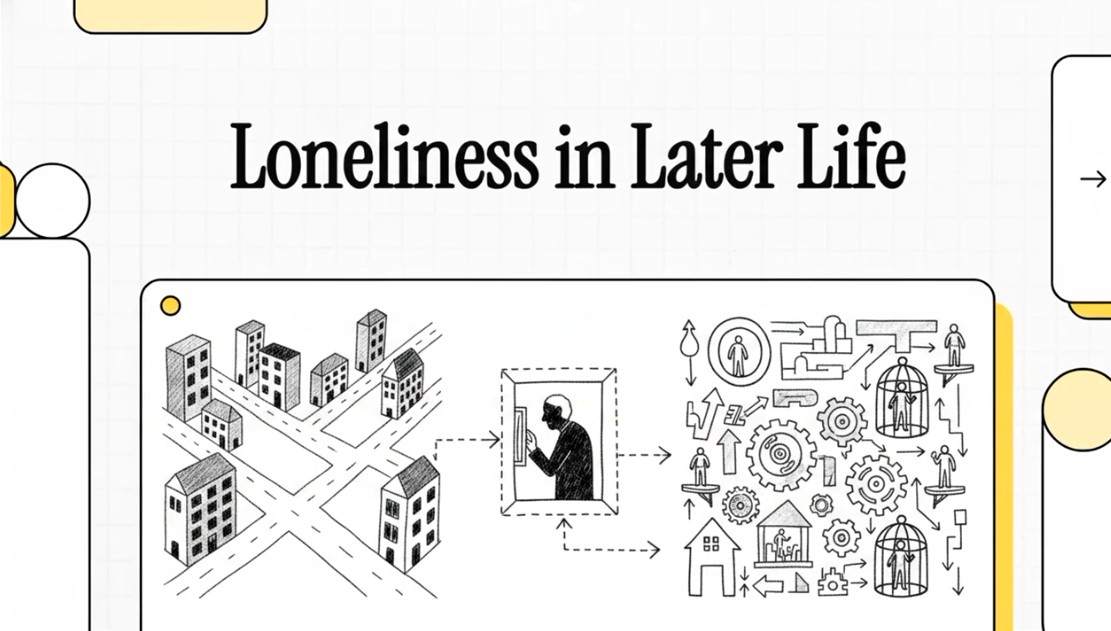
Loneliness in later life is a growing social issue in contemporary societies, intensified by demographic ageing, changes in family structures, and widening social inequalities. In Portugal, one of the most aged countries in Europe, this phenomenon raises important concerns for social justice and the protection of rights in old age. Despite increasing international attention, little is known about how frontline community professionals understand and respond to loneliness among older adults in specific territorial contexts. This study used semi‑structured interviews with six professionals working in different sectors, and the data were analysed through thematic content analysis. Based on these primary qualitative data, the study adopted a qualitative exploratory‑interpretative design to examine loneliness in ageing as a social determinant of mental health from the perspective of professionals in the municipality of Coimbra. The findings reveal five interconnected dimensions shaping experiences of loneliness: critical life transitions, fragile relational networks, territorial constraints, socioeconomic vulnerability, and institutional limitations. These results highlight that loneliness in ageing is a multidimensional and socially produced phenomenon. The study underscores the need for integrated public policies, early and community‑based interventions, and stronger coordination between health, social services, and local networks to promote dignified and socially supported ageing.
Downloads
References
Barbosa, F., Rodrigues, R., & Nunes, C. (2023). Ageing, loneliness and territorial disparities in Portugal: A multidimensional analysis. European Journal of Ageing, 20(1), 1–15. https://doi.org/10.1007/s10433-022-00742-4
Bronfenbrenner, U. (1994). Ecological models of human development. In T. Husen & T. N. Postlethwaite (Eds.), International encyclopedia of education (2nd ed., Vol. 3, pp. 1643–1647). Elsevier.
Bronfenbrenner, U. (2009). Making human beings human: Bioecological perspectives on human development. Sage.
Cabral, M. V., & Ferreira, P. M. (2013). O envelhecimento em Portugal: Desafios contemporâneos. Fundação Francisco Manuel dos Santos.
Cudjoe, T. K. M., Roth, D. L., Szanton, S. L., Wolff, J. L., Boyd, C. M., & Thorpe, R. J. (2020).
The epidemiology of social isolation: National Health and Aging Trends Study. Journal of Aging and Health, 32(9), 1074–1087. https://doi.org/10.1177/0898264320927380
Dahlberg, L., & McKee, K. J. (2022). Loneliness and social isolation in older adults: A scoping review of reviews. Health & Social Care in the Community, 30(3), e1078–e1093. https://doi.org/10.1111/hsc.13697
Flick, U. (2020). An introduction to qualitative research (6th ed.). Sage.
Fonseca, A. M. (2023). Psicologia do envelhecimento e da longevidade. Pactor.
Holt-Lunstad, J. (2021). A pandemic of social isolation? Social isolation and loneliness as public health issues. American Psychologist, 76(3), 293–305. https://doi.org/10.1037/amp0000707
Iecovich, E. (2014). Aging in place: From theory to practice. Anthropological Notebooks, 20(1), 21–33.
Instituto Nacional de Estatística. (2024). Estatísticas demográficas 2024. INE.
Kawachi, I., Subramanian, S. V., & Kim, D. (2013). Social capital and health. Springer.
Mira, M., Pereira, R., & Santos, L. (2025). Loneliness and ageing in Portugal: Social inequalities and territorial disparities. Journal of Aging Studies, 72, 101234. https://doi.org/10.1016/j.jaging.2025.101234
Minayo, M. C. S. (2007). O desafio do conhecimento: Pesquisa qualitativa em saúde (10th ed.). Hucitec.
Patton, M. Q. (2015). Qualitative research & evaluation methods (4th ed.). Sage.
PORDATA. (2025). Índice de envelhecimento em Portugal. Fundação Francisco Manuel dos Santos. https://www.pordata.pt
Simões, A., Santos, A., & Barros, P. P. (2022). Territorial inequalities in ageing: Accessibility, services and vulnerability in Portugal. International Journal of Environmental Research and Public Health, 19(4), 2142. https://doi.org/10.3390/ijerph19042142
Valtorta, N., Hanratty, B., & Tanskanen, A. (2021). Loneliness, social isolation and health outcomes in older adults: A systematic review. The Lancet Healthy Longevity, 2(1), e11–e20. https://doi.org/10.1016/S2666-7568(20)30039-6
Victor, C. R., & Pikhartova, J. (2020). Loneliness in older adults: A cross-national comparison of determinants and trajectories. Journal of Aging and Health, 32(10), 1449–1472. https://doi.org/10.1177/0898264320943336
Weiss, R. S. (1973). Loneliness: The experience of emotional and social isolation. MIT Press.
Wiles, J. L., Leibing, A., Guberman, N., Reeve, J., & Allen, R. E. S. (2012). The meaning of “aging in place” to older people. The Gerontologist, 52(3), 357–366. https://doi.org/10.1093/geront/gnr098
World Health Organization. (2021). Social isolation and loneliness among older people: Advocacy brief. https://www.who.int/publications/i/item/9789240030749
World Health Organization. (2022). World mental health report: Transforming mental health for all. https://www.who.int/publications/i/item/9789240049338
World Health Organization. (2023). Global status report on social connection. https://www.who.int/publications/i/item/9789240084254
Downloads
Published
How to Cite
Issue
Section
License
Copyright (c) 2026 Maria de Lurdes Meireles da Costa, Joana Brinca

This work is licensed under a Creative Commons Attribution-NonCommercial-NoDerivatives 4.0 International License.